Stuck in the Mud

There are two consistent things about living in Nicaragua:

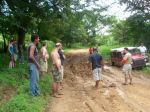
1) If you own a car here (even with 4WD), it is guaranteed to get stuck at some point – in the mud, in a river, in the estuary – somewhere, sometime.

2) If you do get stuck, hordes of people will help you out…and a few will sit and watch the process!

At a time when I was feeling incredibly homesick for the convenience of things in the States, the amount of help we received renewed my faith in living this different lifestyle.

For the new car owner, I suggest purchaing the following items for your car (all easily found in Managua at either PriceSmart, SINSA, or a local ferreteria:

-Durable chain with a hook (for pulling your car out of sticky situations – ropes tend to break)

-Flashlight

-Tire pump (these can be charged at home and then carried in your car or you can plug it into your car’s cigarette lighter)

-Jack

-Jumper cables

-Large jug of water (cars tend to overheat easily here – it’s important to check your fluids regularly and refill your radiator before this happens)

-Patience – can’t buy this one, but be sure to bring plenty with you!


Visas, Residency, and More

Recently, a number of people have asked me for advice on obtaining residency in Nicaragua.  Since Justin and I do not yet have it, I am no expert.  Nevertheless, I thought it might be helpful to post some info I found on the process for those people exploring the option:

Information below was found at the following website:

http://www.travel.state.gov/travel/cis_pa_tw/cis/cis_985.html#entry_requirements

ENTRY/EXIT REQUIREMENTS:  A valid U.S. passport is required to enter Nicaragua.  Although there is a bilateral agreement that waives the six-month validity passport requirement, U.S. citizens are urged to ensure that their passports are valid for the length of their projected stay in the country before traveling.  U.S. citizens must have an onward or return ticket and evidence of sufficient funds to support themselves during their stay.  A visa is not required for U.S. citizens; however, a tourist card must be purchased ($5.00) upon arrival.  Tourist cards are typically issued for 30 to 90 days.

A valid entry stamp is required to exit Nicaragua.  Pay attention to the authorized stay that will be written into your entry stamp by the immigration inspector.  Visitors remaining more than the authorized time must obtain an extension from Nicaraguan Immigration.  Failure to do so will prevent departure until a fine is paid.

There is also a $32 departure tax, the payment of which may or may not be included in your ticket.  If not, payment can be made at the ticket counter.

Per Nicaraguan law, individuals should exit Nicaragua with the same passport with which they entered the country.  Dual national minors who entered Nicaragua on their Nicaraguan passports will be subject to departure requirements specific to Nicaraguan children under the age of 18, even though they may also be citizens of other countries.  More information on these requirements can be found on the U.S. Embassy web site at http://nicaragua.usembassy.gov/dual_nationality.html.  

Also note that all non-Nicaraguan citizens must be in possession of a valid identity document  — passport or Nicaraguan permanent or temporary residency card — at all times while traveling or residing in Nicaragua and may be required to show their documentation to Nicaraguan authorities upon request.

In June 2006, Nicaragua entered a “Central America-4 (CA-4) Border Control Agreement” with Guatemala, Honduras, and El Salvador.  Under the terms of the agreement, citizens of the four countries may travel freely across land borders from one of the countries to any of the others without completing entry and exit formalities at Immigration checkpoints.  U.S. citizens and other eligible foreign nationals, who legally enter any of the four countries, may similarly travel among the four without obtaining additional visas or tourist entry permits for the other three countries.  Immigration officials at the first port of entry determine the length of stay, up to a maximum period of 90 days.  Foreign tourists who wish to remain in the four-country region beyond the period initially granted for their visit are required to request a one-time extension of stay from local Immigration authorities in the country where the traveler is physically present, or travel outside the CA-4 countries and reapply for admission to the region.  Foreigners “expelled” from any of the four countries are excluded from the entire “CA-4” region.  In isolated cases, the lack of clarity in the implementing details of the CA-4 Border Control Agreement has caused temporary inconvenience to some travelers and has resulted in others being fined more than one hundred dollars or detained in custody for 72 hours or longer.

For the most current information about visas to visit Nicaragua, visit the Embassy of Nicaragua web site at http://www.cancilleria.gob.ni/.

http://nicaragua.usembassy.gov/immigration_laws.html

NICARAGUAN IMMIGRATION

U.S. citizens coming for short visits to Nicaragua generally do not need Nicaraguan visas.  However, if you plan to live here on a more permanent basis, you will need to obtain a residency permit.  The best source of information on Nicaraguan Immigration laws is the Nicaraguan government.  We strongly suggest that you contact the Nicaraguan government and/or a Nicaraguan attorney should you have specific questions regarding Nicaraguan immigration laws and procedures.  Hiring an attorney can help guide you through the bureaucratic process.

The information below provides a brief sketch of Nicaraguan immigration procedures and – as Nicaraguan immigration laws change – may not be entirely accurate.

Requesting an Extension of Stay

Nicaraguan Entry/Exit Stamps

Nicaraguan Residency Requirements

Dual Nationality

At the port of entry, Nicaraguan immigration officials determine how long foreign tourists may stay in Nicaragua.  Those entering without a visa generally can stay up to ninety (90) days.  Foreign tourists requesting an extension of stay should apply at the main offices of Nicaraguan Immigration.

Generally speaking, the following is required:

  • Form requesting an extension of stay (available at the Immigration office)
  • Your Passport (valid for at least an additional six months)
  • Your Nicaraguan entry/exit Stamp given to you by Immigration when you entered Nicaragua
  • Fee ranging from approximately $12.00 for one month to less than $40.00 for a three-month extension.

Nicaraguan Immigration imposes a fine on foreigners who exceed their length of stay without proper authorization.  Generally, the fine amounts to a little over $1.00 per day of illegal stay and the foreigner may not leave the country until the fine is paid.  This fine is often waived if the U.S. citizen is a dual national and has a Nicaraguan passport.

If you are a foreign tourist, your Nicaraguan entry/exit stamp or form authorizing an extension-of-stay must be presented to Nicaraguan Immigration prior to departing Nicaragua.

If you cannot present either of these documents, you will need to go to a Nicaraguan immigration office to seek a replacement.

If you cannot present your entry/exit stamp because it was stolen or lost along with your U.S. passport, then the U.S. Embassy can provide you with a letter for Nicaraguan Immigration.  This letter will explain the circumstances surrounding the issuance of the new passport and request the issuance of a replacement entry/stamp stamp.  You will need to present this letter, your new passport, and request form (available in their offices).  Unless you have overstayed the time allotted to you upon entry into Nicaragua, you will not have to pay a fee.

There are two main categories of residency in Nicaragua: permanent and temporary. Under these two main categories exist a wide variety of subcategories with varying requirements.  The best source of information on Nicaraguan residency requirements is the Nicaraguan government and/or a Nicaraguan attorney

The following requirements are common to most subcategories of residency:

  • Residency request form (available at the Immigration office)
  • Your passport (valid for at least an additional six months)
  • Photocopy of every used page of your passport
  • Two Nicaraguan passport-size photographs
  • Criminal background certificate* (requirement waived for minors)
    Health certificate*
  • Birth certificate*
  • Fees ranging from approximately $12.00 for the residence card to $30.00 for the residency fee.

*Please note that the Nicaraguan government has specific requirements for these documents.  You should contact them before you begin this process in order to understand the exact requirements. The Nicaraguan goverment generally requires that documents coming from the United States be aunthenticated. You will need to contact the authenticating authority in the State (or jurisdiction) where the document was issued to initiate this process. In some cases the Nicaraguan goverment has been known to accept copies of documents sworn to be true  and accurate by the bearer and notarized at the U. S. Embassy. Sample language for such a sworn statement can be found here. You should check with the Nicaragua goverment first to understand what they will accept.

Subcategories for permanent residency include:

• Immigrant resident
• Investors
• Resident leasing or renting property or goods
• Retired or pensioned resident
• Resident through family extension

Subcategories for temporary residency include:

• Work-based resident
• Journalist resident
• Student resident
• Religious resident
• Resident through family extension

For more information on requirements and fees for establishing Nicaraguan residency, contact the Nicaraguan government and/or a Nicaraguan attorney. 


1st Anniversary Celebration

This blog has not received the attention it deserves lately as Justin and I just returned from our 2nd trip back to the States.  I asked Justin for advice on what to write about this time around and realized – I think a little to his dismay – that I forgot to put anything up about our first anniversary celebration – oops!

After a few exhausting weeks of work back in August, I had pretty much accepted the fact that we wouldn’t be able to do anything special for our 1st anniversary.  We were both tired, had just spent a good chunk of money on the now infamous Gallo Rojo (our truck) and I knew that I had not pulled together any kind of plans.  

Much to my pleasant surprise, my husband was ahead of the game and booked us a 2-night stay at Hotel Barceló Montelimar Beach.  Since our stay there, I’ve heard many mixed reviews on this place, but I must admit that we thoroughly enjoyed our get-away.  We had a private bungalow, steps from the beach, the largest pool in the Central America, and the hotel’s restaurants.  While this place clearly caters to entertaining large groups (the overly enthusiastic activity planners were proof of this), we were still able to relax, recharge, and enjoy each other’s company.  The food was less than stellar, but the buffet restaurants allowed for feedbag-style portions and guaranteed the ability to find something we both liked for each meal!

Granada Hipica


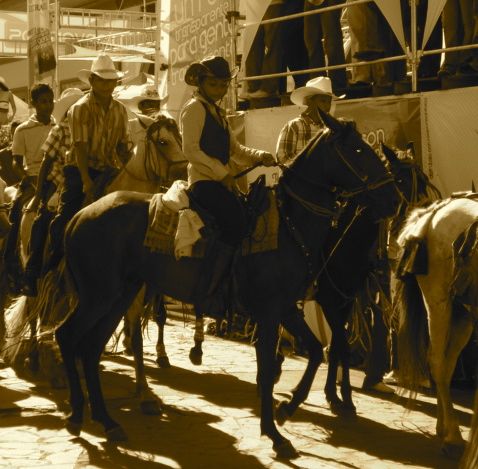
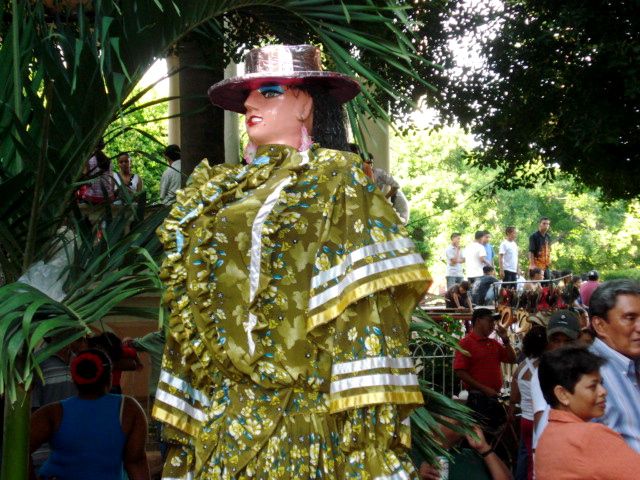
A few weeks ago, we headed north to Granada for one of the larger Hipicas in the country.  A hipica is a grand parade of horses throughout the town, traditionally honoring a well respected community member and often marking the beginning of a fiesta patronal (saint’s day).  Though the temperatures were well above 90 degrees, most of the locals were dressed to the nines in jeans, cowboy boots, hats, and even leather chaps.  Many of the riders wore traditional dress, including full dresses and skirts.  Those not participating in the parade  arrived mostly to eat and drink (a lot).  I’ve been told that historically, it’s rained during the Granada hipica, but on this particular day, it was hot!


Mercado Masaya

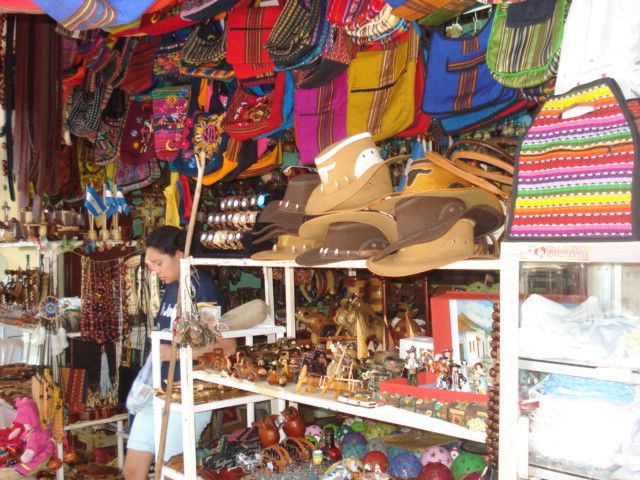
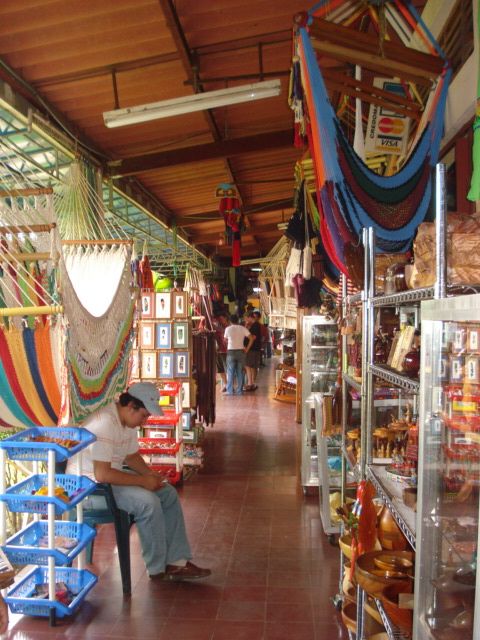
The Mercado Masaya, just south of Managua, is an artisan market offering everything from hand-painted ceramics to crafted wood-work to murals of the surrounding towns to clothing, shoes, and more.  It is a great stop-off on your way into or out of either Granada or Managua and an excellent place to visit if you are looking for gifts to bring home to friends and family.

Canopy Tour of San Juan del Sur


Da Flying Frog Canopy Tour

Da Flying Frog Canopy Tour


One of the great things about having visitors is that they encourage us to explore the tourist activities that we otherwise think we are too busy to experience.  During Emily’s visit, I did just that by throwing in the towel at work one day and heading 5 minutes down the Chocolata to Da Flying Frog Canopy Tour.  It was a last minute decision to go and Da Flying Frog was able to pick us up at the Aurora Office in town and drive us to the base of the zip line, located on the border of a farm.  

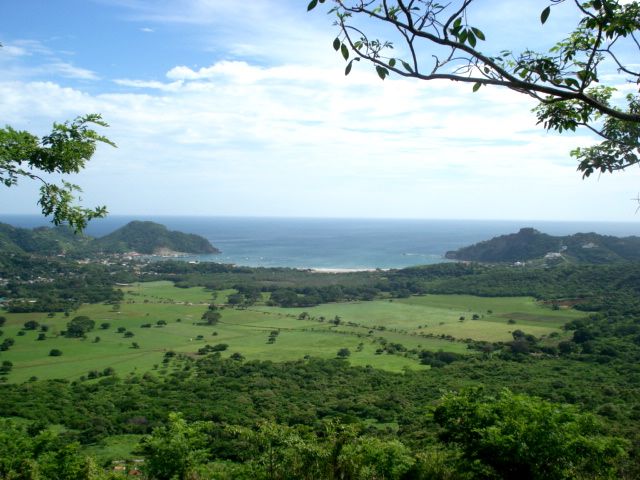
Upon our arrival, the guides gave us a quick tutorial and we headed up the hill in the Jeep.  The Canopy tour starts at the top of a hill, providing commanding views of the Bay of San Juan, the Pacific, and town below.  Once hooked in, you zip between 17 platforms connected by 16 cables, located high above the treetops.  The longest cable is 328 meters; the highest one passes over a canyon measuring 70 meters deep; and at the fastest one you can reach a speed of 70 kilometers per hour.

This is a fantastic way to see San Juan from above – don’t miss out on the opportunity when you visit!


The View from the Start of the Canopy Tour 

Our Awesome Guide

Our Awesome Guide

The View from the Start of the Canopy Tour

The Simple Beauty of Nicaragua

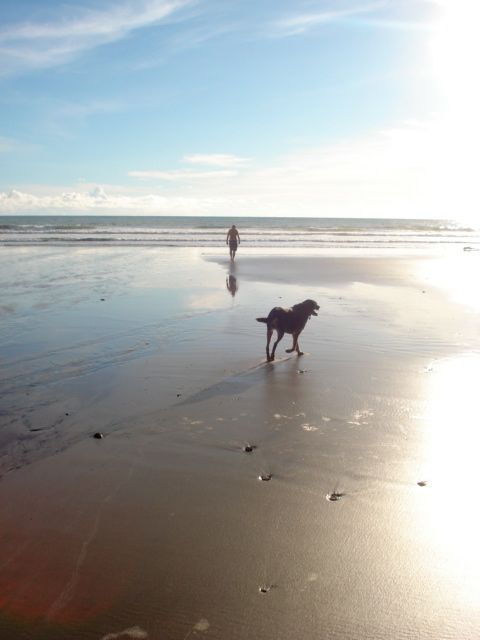
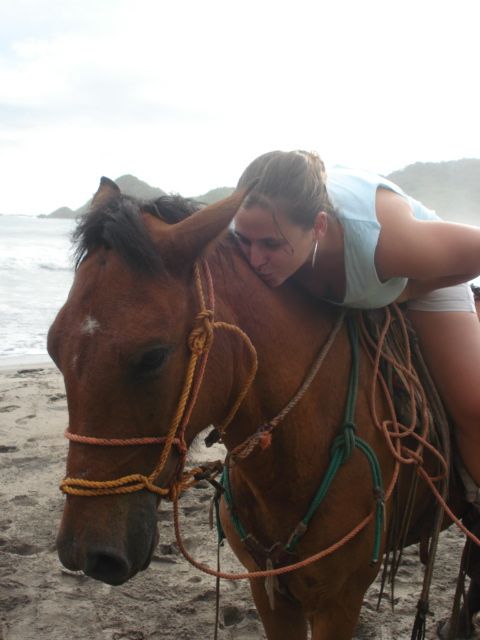
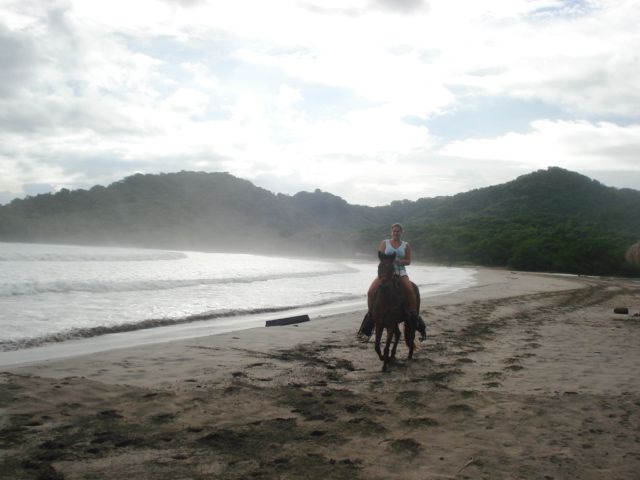
Very few words are needed to describe this amazing experience of riding horseback on the beaches of San Juan del Sur.  A rainy day at Morgan’s Rock turned into an awesome day of adventure including the beach, horses, and even a double rainbow.